
Village in the Shade Tool Upgrades: Anvil, Molds and Ingot Materials
Plan Village in the Shade tool upgrades with Anvil checks, mold prices, ingot processing, tool effects, and Seeder unlock requirements.
What should you check before upgrading a tool?
For Village in the Shade tool upgrades, work backward from the task you need to do: check the yard Anvil for the tool’s displayed recipe, confirm that the relevant mold is available, then turn matching ore into ingots if the recipe calls for them. Don’t buy every mold or smelt every ore type on the assumption that you’ll need it immediately. Complete Anvil upgrade recipes have not been verified for this guide, so the Anvil’s own requirements are the final check before you spend materials.

The Perfect Farming Sim for Halloween is here! Village in the Shade · Josh's Gaming Garden
General reference: third-party English-language gameplay of the original 2026 game. This is not a dedicated tutorial for the topic below, a device benchmark, or evidence of extracted values, quest order, or Patch 1.30 behavior.
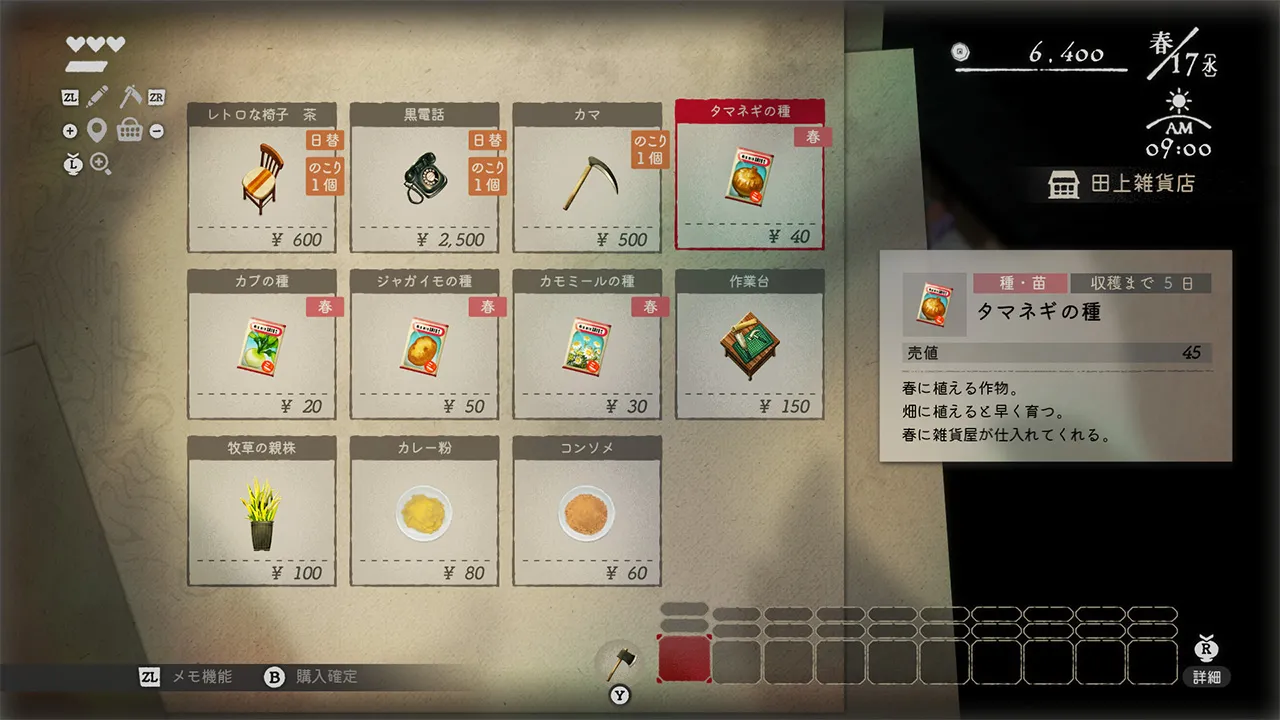
Cover context: Official original-game General Store screenshot with tool and seed listings. Japanese UI is retained. This is general shopping context, not a picture of the Anvil or proof of mold prices, upgrade ingredients, or unlock conditions.
Start with the Anvil and the store
Use this checklist when you’re ready to pursue an upgrade:
- Check whether the yard Anvil is built. Extracted General Store mold entries carry a built-Anvil stock condition; they do not establish an exact first day on which molds appear.
- Check for the mold-shopping letter and revisit the store. A hands-on tool guide reports that a letter precedes mold shopping and that non-quest upgrades use the yard Anvil. Treat that as an attributed report, not a verified universal schedule.
- Open the Anvil option for the tool you want. Read its displayed inputs before buying a mold, smelting ingots, or setting aside other items. The available evidence does not confirm full upgrade quantities, fees, mold consumption, or whether tiers can be skipped.
- Prepare the missing material, then check again. If the recipe asks for an ingot, ore alone is not a substitute.
If Copper is your immediate obstacle, the separate Copper Mold guide covers that item without requiring you to plan the entire tool lineup at once.
Mold prices: budget for purchase, not resale
These are selected data-snapshot prices, not a claim that the current English Patch 1.30 store or every console has been retested. “Iron Mold” is an editorial rendering of the mold record; Steel is the Japanese tool-tier label, while that tier’s metal material is Iron Ingot. There is no Silver Mold in the selected records.
| Mold | Buy (¥) | Sell (¥) | Practical budget check |
|---|---|---|---|
| Copper Mold | 1,000 | 750 | Check the first upgrade you intend to make. |
| Iron Mold | 3,000 | 2,250 | Check recipes for tools labeled Steel-tier. |
| Gold Mold | 10,000 | 7,500 | Save toward the buy price, not 7,500. |
| Meteoric Iron Mold | 20,000 | 15,000 | Confirm the intended upgrade before committing. |
Source: extracted item records, Steam build 25311578. These are purchase and resale fields in an unofficial extraction, not our playtest. The General Store stock records also attach a built-Anvil condition to mold stock; they do not establish a calendar unlock date.
The table is a shopping reference, not an Anvil recipe. In particular, a mold’s price does not tell you whether an upgrade consumes it. Check the displayed recipe and your inventory before treating any mold as a one-time or reusable purchase.
Turn ore into the ingot the recipe requests
The extracted furnace processes cover Copper, Iron, Gold, and Meteoric Iron Ingots. For each one, the recorded conversion is 5 matching ore plus 1 charcoal or 1 coal → 1 matching ingot. That means you can choose either listed fuel for a batch; you do not need both. The ingot descriptions indicate about 12 hours. Check the timer displayed by your own furnace before scheduling another batch. Sources: extracted metal-processing recipes and extracted item descriptions.
A useful sequence is to inspect the Anvil first, count the ingots it actually requests, and only then gather matching ore and fuel. For example, Steel-tier wording on a tool is a reason to check your Iron Ingot supply—not to hunt for an unsupported silver material. If ore is your bottleneck, the mining guide is the relevant next stop. If money for a mold is the bottleneck, plan that purchase separately from smelting; furnace output does not establish the rest of an upgrade recipe.
Pick upgrades by the work they unblock
The selected item descriptions show why the “best” next tool depends on your current job. In this comparison, Steel names the tool tier associated with iron; the labels are editorial translations of extracted Japanese and Chinese records, not verified English UI strings.
| Tool | Base → Copper | Steel → Gold → Meteoric Iron | When to prioritize it |
|---|---|---|---|
| Axe | Mature tree: 8 → 6 hits. Copper can break logs. | Mature tree: 4 → 2 → 1 hits; higher tiers describe additional stump or fallen-wood obstacles. | A wood obstacle or repeated tree clearing is holding up your plan. |
| Pickaxe | Small stone: 5 → 3 hits. Copper can break round rocks. | Small stone: 2 → 1 hits at Steel and Gold; later tiers describe additional rock types. Meteoric Iron also breaks a round rock in one hit. | A rock type blocks access, or mining trips are taking too much work. |
| Hoe | Tills 1 tile → 2×2 tiles. | Tills 3×3 → 4×4 → 5×5 tiles. | You are preparing enough field space for wider coverage to matter. |
| Watering can | Waters 1 → 2 tiles ahead; Copper holds water for 80 tiles when filled. | Waters 3 → 4 → 5 tiles ahead; listed capacities are 120 → 160 → 240 tiles. | Daily watering coverage or refills are your recurring bottleneck. |
| Plow | Makes paddy ground across 1 tile → 2×2 tiles. | Covers 3×3 → 4×4 → 5×5 tiles; descriptions caution that paddies have surrounding embankments. | You are laying out substantial paddy space. |
Source: selected tool descriptions in the extracted item records for Steam build 25311578. The figures describe those records, not a current-version hands-on comparison.
Choose for access before convenience. If a specific rock or wood obstacle stops your next project, compare the relevant pickaxe or axe description with that obstacle first. If access is already fine, choose the repetitive job you actually do most: watering a working farm may be more valuable to you than expanding tilling width, while a new field may favor the hoe. The farming guide can help you think through that workload. These are decision rules, not a guaranteed optimal upgrade order.
Patch 1.30 Seeder: a separate unlock path
The official Free Update 2 / Patch 1.30 announcement adds the Seeder. It requires the crossroads hokora to be restored to at least stage three; a letter then precedes its General Store purchase. The Seeder sows seeds, plants seedlings, and spreads fertilizer over three tiles ahead, and its reach can be upgraded at the Anvil.
Treat this as an additional tool path, not evidence that only the tool families in the comparison table can ever be upgraded. If the Seeder letter or purchase option has not appeared, verify the hokora requirement first. The announcement also notes that certain main-story sections or thunderstorms may block update events; it does not establish that rule for every other event in the game.
If an option is missing, isolate the missing step
- No mold in store: Check that the Anvil is built, then check for the reported letter and revisit the stock. Neither source supplies a guaranteed unlock day.
- Have ore but lack an Anvil input: Read the input’s exact material type. If it says ingot, process matching ore with charcoal or coal in a furnace and collect the output.
- Can see a mold but cannot afford it: Use its buy column above. The Gold Mold’s 7,500 figure is resale, not the 10,000 purchase price.
- Have materials but cannot complete an upgrade: Reopen that specific Anvil option and compare every displayed requirement with what you hold. This guide cannot safely fill in unverified quantities, fees, or tier prerequisites.
- Missing the Seeder: Check the crossroads hokora stage and letter path rather than assuming an ordinary mold-stock check will unlock it.
FAQ
Is Steel made with Silver Ingots?
No Silver Mold appears in the selected mold records. Steel is the tool-tier label; Iron Ingot is the associated metal material. Check the Anvil for the exact input to your chosen upgrade.
Does ore count as an ingot at the Anvil?
Do not assume so. The extracted furnace processes turn 5 matching ore and 1 charcoal or coal into 1 ingot. Follow the material name shown in your Anvil recipe.
Should I buy every mold as soon as it appears?
Not necessarily. First identify the tool upgrade that addresses your current obstacle or repeated task, then confirm its Anvil requirements. Mold prices alone do not establish upgrade recipes.
Can the Seeder be upgraded too?
Yes. The official Patch 1.30 announcement says its reach can be upgraded at the Anvil, after its separate hokora-and-letter unlock path makes the tool available.
Continue with related guides
Media sources
Related Articles
guide
Village in the Shade Copper Mold: Shop Reports and Upgrade Checks
Community references identify the Copper Mold as a tool-upgrade item and point to Sazanka’s General Store, with a reported price of 1,000 yen.
guide
Village in the Shade Farming Guide: Fields, Seasons and Crop Costs
Plan fields, ridges and paddies with selected crop costs, season windows, rice timing and planting checks.
guide
Village in the Shade Guide: Farming, Mining, and Beginner Tips
A Village in the Shade guide to farming, animal care, hunting permits, quarry shortcuts, friendships, modes, and later milestones.
Was this helpful?
Thanks for the feedback!